
The 2026 financial year (1 July 2025 – 30 June 2026) has now ended, which means it's time to pull together your records and get your returns lodged. We're here to guide you through it - with the knowledge and experience to advise what you need to do, and to make lodging your (or your entity's) return as straightforward as possible.
To make it easy, we've prepared our 2026 Individual Tax Return Checklist. Tick each item that applies to you, note the amount where you know it, and attach your supporting documents. Anything that doesn't apply, simply leave blank. You can find the checklist here.
What we'll need from you
The checklist is organised into the following sections. Here's what sits behind each one:
Residency and visa status
Tax residency isn't the same as citizenship or your immigration status. Let us know if you arrived in or departed Australia during the year, held a 417 or 462 working holiday visa at any time, held any other temporary visa, or lived or worked overseas. Part-year residency changes your tax-free threshold, and working holiday makers are taxed differently from the first dollar.
Income
Salary and wages from all employers (income statements are usually pre-filled by mid-July, but tell us of any employer not showing), allowances, tips, directors fees and commissions, employment termination or redundancy payments, and Australian government payments such as Centrelink pensions or JobSeeker. Also bank and term deposit interest, dividend statements, managed fund and trust annual tax statements, partnership or trust distributions, superannuation income streams and lump sums, foreign income and assets, and other income including gig or platform work. Where you have provided your tax file number to the bank/investment provider this information may be provided to us by the ATO.
Rental property
One set of records for each property, with the address, ownership percentages and the dates it was available for rent. We'll need the annual statement from your managing agent, loan interest and bank fees, council rates, water, land tax, strata and insurance, invoices for repairs and capital works over $300, a quantity surveyor depreciation schedule if you have one, and the settlement statement if the property was bought or sold.
Capital gains
Buy and sell contract notes for shares or units sold, the contract and settlement statement plus original purchase costs for any property sold or contracted, a full transaction export for crypto assets disposed of, swapped or spent, and any prior year capital losses carried forward.
Sole trader or business
Business income and expense records (accounting file access, or a summary plus full-year bank statements), BAS lodged and GST reconciliations, asset purchases and disposals with invoices and finance agreements, closing stock, debtors and creditors at 30 June 2026, and wages paid, super guarantee and PAYG withheld.
Work-related deductions
The three rules
-
You need a record for every claim.
-
There must be a direct connection to earning your income.
-
You must not have been reimbursed.
This covers car expenses (logbook or work kilometres - home to work travel usually isn't claimable), overnight travel and accommodation, compulsory or protective uniforms and laundry, self-education related to your current work, hours worked from home, the work-use portion of phone and internet, tools, equipment, computers and software, union fees and professional memberships, and other work-related expenses.
Other deductions and super
Donations to deductible gift recipients (raffle tickets and dinners don't count), income protection insurance premiums held outside super, interest and fees on investment loans, the cost of managing your tax affairs, personal super contributions you intend to claim, and spouse or downsizer contributions. If you're claiming a personal super contribution, your fund must acknowledge your notice of intent before we lodge.
Offsets, Medicare and income tests
Your private health insurance annual tax statement (needed for everyone on the policy), any Medicare levy exemption or reduction, seniors and pensioners offset, zone or overseas forces offset, invalid or carer offset, your HELP, VSL or other study loan balance, and income test items such as reportable fringe benefits and salary sacrifice to super.
A few things people commonly miss
Every year a handful of items hold returns up. Worth checking now:
- Your notice of intent for personal super contributions - your fund has to acknowledge it before we can lodge the deduction.
- The private health insurance statement for everyone on the policy, including any period without cover.
- Managed fund annual tax statements, not just the distribution advice - the two report different figures.
- Crypto disposals, including swaps and anything spent, not only sales to cash.
- A record of hours worked from home kept as you went, rather than reconstructed at year end.
- Anything unusual this year — marriage or separation, an inheritance, moving overseas, starting a business, or a large one-off amount.
What happens next
- Before we begin work, we will send you an engagement letter explaining the fees and services for you to review and sign.
- Once we receive this back, we will prepare your tax return and send it to you to check and approve.
- When your signed documentation comes back, we lodge it with the ATO.
Please note
Please keep copies of your records for five years from the date you lodge, including the return, attachments and all supporting papers.
Download the checklist
Download the 2026 Individual Tax Return Checklist
Questions?
The above is general information and does not take account of your personal circumstances. Please contact us to discuss how it applies to you.
From 1 July 2026, new Australian laws require accounting firms like ours to verify the identity of our clients before providing certain services. This is a legal requirement — not a change to how we work with you — and most people will find it quick and simple.
Australia has extended its Anti-Money Laundering and Counter-Terrorism Financing (AML/CTF) legislation to cover a broader range of professional services, including accounting. These changes are part of a broader effort to bring Australia in line with global standards and ensure our financial system remains transparent and secure.
The 2026–27 Federal Budget introduces some of the most significant proposed tax reforms Australia has seen in decades.
The Government’s focus is centred around housing affordability, reducing tax concessions for existing property investors, increasing support for workers, and restructuring long-standing taxation arrangements involving capital gains and discretionary trusts.
While many of these announcements are still proposals and have not yet been legislated, the changes could significantly impact investment decisions, property purchases, business structures, and long-term wealth planning strategies.
The revised stage 3 tax cuts have recently passed the senate (27th February 2024) and will be implemented from 1 July 2024.
By Leah Groves, Associate Director
In a world where many industries are facing staffing challenges, internships can offer a time-tested solution, giving students invaluable real-world experience while also providing businesses with a range of benefits.
New Staff Members to Join Lee Green in New Financial Year.
In July, we will have the pleasure of welcoming three new staff members from local firm PT & Co Chartered Accountants to Lee Green.
The combined team will operate as Lee Green from our Adelaide offices, located at 190 Fullarton Road, Dulwich.

Happy 30th Anniversary Lee Green!
Did you know that Lee Green turns 30 this year? Before we get started on celebrations for our 30th anniversary, we are throwing it back to 10 years ago and our 20th anniversary celebrations at Adelaide Oval with some photos and excerpts from Director Tom Green’s speech.
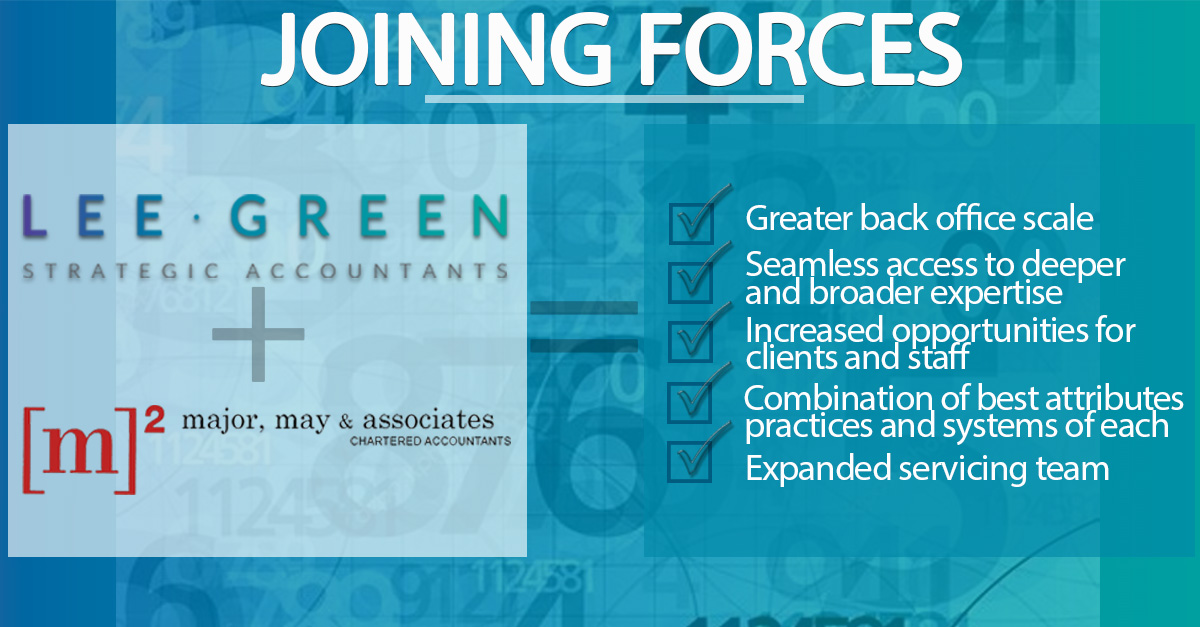
Lee Green is joining forces with fellow accounting services firm Major May on 1 July 2018 to create multiple benefits for clients and staff.
The merger will provide our clients with the benefit of greater back office scale and seamless access to deeper and broader expertise – all without the bureaucracy of larger firms.
Our practices are similar and very culturally compatible. Both are committed to ensuring their high levels of client knowledge and service continue under the merged structure. Bringing the two firms together will also create increased opportunities for staff in terms of professional development, expanded experiences and career advancement.

Russell Bedford appoints its first firm in Adelaide
The strong Asian connections of Adelaide strategic accounting firm Lee Green & Co have attracted the interest of global accounting network, Russell Bedford International.
Announcing the appointment of Lee Green as its first South Australian member firm, the Melbourne-based Asia-Pacific regional director of Russell Bedford International, Mr Bruce Saward said the firm was an ideal fit with the network’s other Australian offices.
"We are delighted to welcome Lee Green & Co into Russell Bedford's family of firms,” Mr Saward said.
“As a growing practice with a strong track record in providing services to inbound investors, the firm represents a great fit alongside its fellow members in Australia."